What to see in Aínsa: a comprehensive guide to visiting the medieval village in Sobrarbe
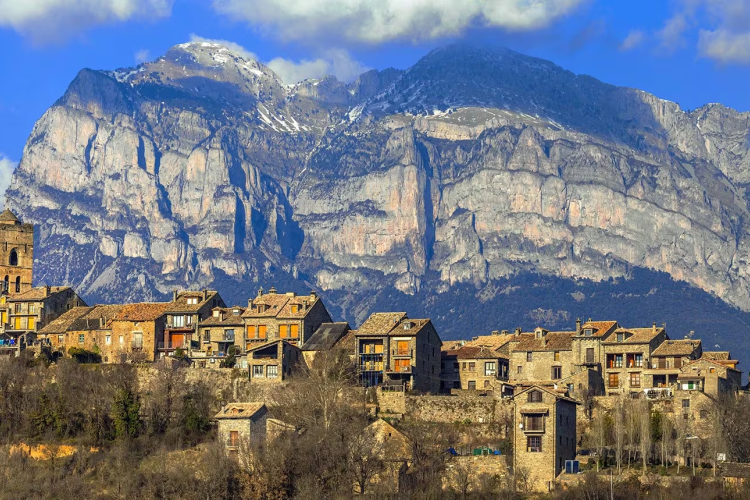
If you’re looking for things to see in Aínsa, you’ve found the guide you need. This small Pyrenean village in the Sobrarbe region (Huesca, Aragon) packs into just a few hectares one of Spain’s best-preserved medieval old towns, the gateway to the Ordesa and Monte Perdido National Park, and a breathtaking mountain landscape. And just over 55 kilometres away, at the foot of those very same Pyrenees, lies the Somontano DO, the Aragonese designation of origin whose name says it all: ‘at the foot of the mountains’.
Exploring Aínsa and combining your getaway with a visit to a winery is one of the most well-rounded experiences that inland Aragon has to offer. In this guide, we’ll tell you everything you need to know.
Aínsa: history and first impressions
Aínsa is the capital of the Sobrarbe region and has a population of around 2,100. Its old town was declared a Historic-Artistic Site in 1965 and forms part of the UNESCO Sobrarbe-Pyrenees Global Geopark, which spans 550 million years of geological history. According to historical tradition, the Kingdom of Sobrarbe was founded here in the year 724, when the chieftain García Jiménez defeated the Muslims following the miraculous appearance of a cross above an oak tree — a symbol that now forms part of the coat of arms of Aragon. The first documented charter of repopulation dates from the reign of Alfonso I the Battler, in 1124.
The result of all this history is a village of stone, arches and slate roofs that seems frozen in time.
What to see in Aínsa: the must-sees
The Main Square
Aínsa’s Plaza Mayor is, without a doubt, the first place to visit. Dating from the 12th and 13th centuries, it is considered one of the most beautiful medieval squares in Spain. It is a porticoed square, with Romanesque arches and stone columns, and is surrounded by medieval palace houses and the Town Hall building. Covering almost 1,800 m², it is the perfect spot to sit on a terrace and soak up the atmosphere before continuing your visit.
Aínsa Castle
Built in the 11th century to defend Sobrarbe and extended in the 16th century as a defence against possible French invasions, the castle is the highest point in the town. Its keep, with a pentagonal floor plan, offers panoramic views over the Cinca valley and the Mediano reservoir. Inside, it houses the Ecomuseum of Pyrenean Fauna and the Sobrarbe-Pyrenees Geopark Interpretation Centre. In summer, concerts are held in the castle’s moat as part of the Aínsa Castle International Festival.
The Church of St Mary
Built in the 11th century in the Romanesque style, this former collegiate church is notable for its square bell tower, visible from all over the town, and for its 14th-century cloister with an irregular floor plan. The tower is open to visitors and offers views over the medieval rooftops and the mountains, which alone make the climb worthwhile.
Nature and activities around Aínsa
The Añisclo Gorge and the Ordesa and Monte Perdido National Park
Aínsa is the gateway to some of the most spectacular landscapes in the Pyrenees. Less than 40 km away lies the Añisclo Canyon, part of the Ordesa and Monte Perdido National Park (a UNESCO World Heritage Site since 1997). It can be reached from the village of Escalona, about a 10-minute drive from Aínsa. The Ordesa Valley, with the Cola de Caballo trail (17 km), and the Pineta Valley, with its imposing glacial cirque, can also be reached in under an hour.
The River Ara: rafting and water sports
The River Ara rises in the Vignemal glaciers and has over 40 km of navigable water, with ideal conditions for rafting between April and July. Companies such as Aguas Blancas (founded in 1991) offer rafting, kayaking and canyoning from Aínsa and Broto.
The Mediano Reservoir
Visible from the castle, the Mediano reservoir is a unique attraction: when the water level drops, the bell tower of the village of Mediano – which was flooded in the 1960s – emerges. Kayaking, stand-up paddleboarding and sailing are popular activities on its shores.
Summer events and festivals
July is a particularly lively month in Aínsa. The Castillo de Aínsa International Festival, which specialises in folk and roots music, will celebrate its 35th anniversary in 2026 with performances in the castle moat, the Plaza Mayor and the streets of the historic centre. Many concerts are free to attend. Furthermore, in even-numbered years (such as 2026), La Morisma takes place at the end of August – a historical re-enactment designated a Festival of Tourist Interest in Aragon, in which more than 300 local actors re-enact the founding battle of the Kingdom of Sobrarbe
How to get to Aínsa
The most convenient option is to go by car. From Zaragoza, Aínsa is about 170 km away via the A-23 towards Huesca and the N-260 towards the Pyrenees, a journey of approximately 2 hours. From Huesca city centre, the distance is about 100 km (1 hour 15 minutes). There is no direct train service; travelling by car also allows you to explore the surrounding area at your leisure.
From Aínsa to Somontano: a blend of mountains and wine
Just over 55 kilometres south of Aínsa, with the mountains now behind you and the vineyards stretching out before your eyes, lies Barbastro, the capital of the Somontano Designation of Origin. The name is no coincidence: ‘Somontano’ literally means ‘below the mountains’. The very same Pyrenees that can be seen from the battlements of Aínsa Castle are what shape the climate and the aromas of the wines produced by Viñas del Vero.
Viñas del Vero, a winery founded in 1986 and based in Barbastro, offers guided tours, walks through the vineyards and wine tastings that bring the getaway full circle: mountains in the morning, wine in the afternoon.
Wine cellar tours and wine tourism in Viñas del Vero →
Bodega Secrets Club — exclusive access to wines and special offers →
Where to stay and practical tips
Aínsa offers a good range of rural accommodation, mainly in the historic centre and the surrounding area. The best time to visit the village is in spring (May–June) and autumn (September–October), when temperatures are pleasant and there are fewer tourists. In July, the village comes alive thanks to the festival, but it is advisable to book in advance.
Frequently Asked Questions
What to see in Aínsa in a day?
In a single day, you can visit the three main monuments in the historic centre: the medieval Plaza Mayor (12th–13th centuries), Aínsa Castle (11th century, home to the Pyrenean Fauna Ecomuseum) and the Church of Santa María (Romanesque, with a 14th-century cloister). Round off the day with a stroll through the historic centre and, weather permitting, a quick trip to the Mediano reservoir, just a few kilometres away. Set aside at least the afternoon to climb up to the castle at sunset.
How long does it take to visit Aínsa?
To explore the historic centre at a leisurely pace, without rushing, 3–4 hours should be enough. If you want to combine your visit with a trip to the Añisclo Canyon or the Ordesa Valley (both less than 45 km away), allow at least a full day. A two-day stay gives you plenty of time to explore the village and the surrounding countryside at your own pace.
How do you get to Aínsa from Zaragoza?
The most convenient option is to go by car. From Zaragoza, Aínsa is about 170 km away via the A-23 towards Huesca and then the N-260 or A-138 towards the Pyrenees. The journey takes approximately 2 hours. There is no direct train service; travelling by car also allows you to explore the surrounding area at your leisure: the canyons, valleys and wineries of the Somontano region.
Is Aínsa in the Pyrenees?
Aínsa is technically situated in the Pre-Pyrenees, in the Sobrarbe region (Huesca, Aragon), at the foot of the Aragonese Pyrenees. It is the capital of Sobrarbe and the gateway to the Ordesa and Monte Perdido National Park. The Pyrenean peaks can be seen from Aínsa Castle. The area forms part of the UNESCO Sobrarbe-Pyrenees Global Geopark.
Is it worth combining a visit to Aínsa with a visit to a winery in Somontano?
Absolutely. Aínsa and the Somontano Designation of Origin are 55 km apart, about a 46-minute drive by road. Viñas del Vero, the leading winery in the Somontano region, is based in Barbastro and offers guided tours, vineyard walks and wine tastings. Combining medieval mountain scenery and wine culture in a single getaway is one of the most well-rounded experiences that inland Aragón has to offer.
What is the best month to visit Aínsa?
Spring (May–June) and autumn (September–October) are the best months: pleasant temperatures, fewer tourists and spectacular scenery. July offers more cultural events, particularly the Aínsa Castle International Festival, but also attracts more tourists. In even-numbered years (such as 2026), the end of August sees La Morisma, the town’s major historical re-enactment.